|
 Haversacks
- copied from a British original formerly in the private collection of J.Craig
Nannos, and made from unbleached Osnaburg linen, 16 ¾" wide
by 13 ½" tall. Available as completely handsewn or in kit
form. The kit contains pre-cut linen, linen thread and beeswax to coat thread, buttons (three ¾"
pewter buttons on plain version or three ¾" brass buttons on
British version), and instructions. Haversacks are very easy to make.
The handsewn haversacks are ready to use. Haversacks
- copied from a British original formerly in the private collection of J.Craig
Nannos, and made from unbleached Osnaburg linen, 16 ¾" wide
by 13 ½" tall. Available as completely handsewn or in kit
form. The kit contains pre-cut linen, linen thread and beeswax to coat thread, buttons (three ¾"
pewter buttons on plain version or three ¾" brass buttons on
British version), and instructions. Haversacks are very easy to make.
The handsewn haversacks are ready to use.
The shoulder strap on the original haversack, excluding the 3" sewn to the sack, is 34" long. That length seems to fit a majority of people. The kits have a strap 43" long which is more than long enough for nearly everybody and you likely will have to cut off the excess for a proper fit. However if you should need a longer shoulder strap I can provide one up to 48" upon request. When worn correctly the top of the haversack should be several inches above your elbow. The straps on the handsewn haversacks will be the same as the original 34" length unless you specify another length.
British version
with GR and Broad Arrow $63 handsewn or $18 kit.
Plain version $60 handsewn or $15 kit.
Cuthbertson writes
(pg.85, XLIV), "...a Soldier cannot conveniently get through the
Duties of a Campaign, without a Haversack of strong, coarse, grey linen
(which is always issued as part of the Camp-equipage) to carry his bread
and provisions on a March..."
 For pictures of the original British haversack click the GR and Broad
Arrow. For pictures of the original British haversack click the GR and Broad
Arrow. |
| Camp Kettle Bag
Kit - based on an illustration in the 1788 German book, "What Every
Officer Needs to Know During a Campaign". When the camp kettle was
not in use, it was stored or carried in a bag such as this. The kit includes
Osnaburg linen, linen thread, beeswax to coat thread, hemp twine for drawsting, hemp webbing, iron
buckles, and instructions. $25 |
Wallet -
based on an original in the Sebastian Goundie House at Historic Bethlehem,
PA. Wallets were rectangular linen bags used by the military as a type
of knapsack. The soldiers necessarys were placed into the wallet, and
then the wallet was rolled up inside the soldiers blanket which was to
be slung on his back. Wallets were also used by civilians to carry belongings,
much as a fabric shopping bags is used today, but not having any handles
the wallet was draped over arm. Kit includes Osnaburg linen fabric, linen
thread, beeswax to coat thread, linen tape, and instructions.
Small (13" x 35") $9 kit, or $39 handsewn
Large (14" x 39") $12 kit, or $44 handsewn
The Orderly Book of the 40th Foot in May 1777 mentions wallets several
times. Among the orders are: The Necessarys to be carried in their
Wallet and slung over the Right Shoulder... Each Compy will immediately
receive from the Qr. Mr. Serjt 26 Slings & Wallets to put the quantity
of Necesareys Intendd. to be Carrid. to the field Viz 2 shirts 1 pr of
shoes & soles 1 pr of stockings 1 pr of socks shoe Brushes, black
ball &c Exclusive of the Necessareys they may have on (the[y] must
be packd. in the Aranged manner & the Blankts. done neatly round very
little longer than the Wallets) to be Tyed. very close with the slings
and near the end ... The Non Commissd Offrs and Men to have their Necessareys
Constantly packd in their Wallets ready to sling in their Blanketts which
they are to parade with Every morning at troop beating to Acustom them
to do it with Readiness and Dispatch ... Each Company to give in a Return
to the Quarr Masr of the Number of Wallets & Slings wanting to compleat
each Man as the whole must have them to appear uniform in the slinging
on & Carrying their Blankets & Necessarys -- Any of the Wallets
or Slings not properly made to be returned to the Masr Taylor --
Blanket & Wallet Roll Sling -
made of hemp linen webbing and based on the 40th Foot Orderly Book and depicted in circa 1777 and 1800 paintings. The narrow ends of the sling tie around the ends of the blanket roll with the wider webbing resting against the chest. The $15 kit includes pre-cut webbing, sewing needle, waxed linen thread, and instructions. Also available completely hand sewn and ready to use for $25. |
 Blackball
- This is a one ounce ball made of beeswax, lampblack and mutton tallow that was
used to help "waterproof" and polish shoes, scabbards and cartridge
pouch flaps. Blackball is often mentioned in 18th journals and orders as
being one of the items that soldiers include in their "kit" along
with extra shoe soles and heels and a brush to apply the blackball. Cuthbertson
writes (pg.85, XLIII), "knapsacks...should be made with a division,
to hold the shoes, black-ball and brushes, seperate from the linen..."
Cuthbertson also recommends the use of lampblack and beeswax on scabbards
and pouch flaps (pg.100, XXIX) and blackball on shoes (pg.114, XVII), "...every
soldier should be furnished with a pair of shoe-brushes, and a blacking
ball of good ingredients, that there may be no excuse, for not having at
all times their shoes and gaiters extremely clean and highly polished." Out of stock Blackball
- This is a one ounce ball made of beeswax, lampblack and mutton tallow that was
used to help "waterproof" and polish shoes, scabbards and cartridge
pouch flaps. Blackball is often mentioned in 18th journals and orders as
being one of the items that soldiers include in their "kit" along
with extra shoe soles and heels and a brush to apply the blackball. Cuthbertson
writes (pg.85, XLIII), "knapsacks...should be made with a division,
to hold the shoes, black-ball and brushes, seperate from the linen..."
Cuthbertson also recommends the use of lampblack and beeswax on scabbards
and pouch flaps (pg.100, XXIX) and blackball on shoes (pg.114, XVII), "...every
soldier should be furnished with a pair of shoe-brushes, and a blacking
ball of good ingredients, that there may be no excuse, for not having at
all times their shoes and gaiters extremely clean and highly polished." Out of stock |
 Canteen Cork Stopper-
a tapered 1" tall cork for canteens or bottles. Corks are made in three quality levels: Standard, Premium, and Extra Select. Better quality corks have fewer cracks and crevices. I stock corks in the Standard and Premium grades. Standard quality corks are great for dry goods and standing liquids. Premium quality corks are used when transporting liquids. Canteen Cork Stopper-
a tapered 1" tall cork for canteens or bottles. Corks are made in three quality levels: Standard, Premium, and Extra Select. Better quality corks have fewer cracks and crevices. I stock corks in the Standard and Premium grades. Standard quality corks are great for dry goods and standing liquids. Premium quality corks are used when transporting liquids.
Small (5/8" bottom diameter, 13/16" top diameter) Standard grade is not available. Premium grade $0.75 each
Medium (5/8" bottom diameter, 7/8" top diameter) -
fits most G.G. Godwin & T.W. Moran canteens
Standard grade $0.50 each, Premium grade $0.75 each
Large (13/16" bottom diameter, 1-1/16 top diameter) - fits
most Carl Giordano canteens. Standard grade $0.75 each, Premium grade $1.50 each |
|  Garters
- black leather with solid brass, flat buckle. Garters
- black leather with solid brass, flat buckle.
5/8" wide $8/pr ;
3/4" wide $9/pr ;
1" wide $10/pr.
Please specify upper calf measurement (measure just below your knee) while
wearing 18th C. clothing.
 Cuthbertson
writes (pg.114, XVIII)"...black leather garters, buckled below
the knee, ... the breadth of these garters should be about an inch".
Please note that the buckles used are not authentic reproductions but
they are very close in appearance to the small, simple buckles found on
many Rev War sites and seen in Loutherburg's rear view of the 69th Foot
grenadier at Warley Camp. In the 1960's a 1" wide British knee garter strap, along with 44th Foot buttons, was excavated in Philadelphia during construction of Interstate 95. Cuthbertson
writes (pg.114, XVIII)"...black leather garters, buckled below
the knee, ... the breadth of these garters should be about an inch".
Please note that the buckles used are not authentic reproductions but
they are very close in appearance to the small, simple buckles found on
many Rev War sites and seen in Loutherburg's rear view of the 69th Foot
grenadier at Warley Camp. In the 1960's a 1" wide British knee garter strap, along with 44th Foot buttons, was excavated in Philadelphia during construction of Interstate 95.
|
|
Neckstocks
- Please specify neck measurement (your dress shirt neck size).
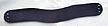 Black leather
with cotton ties $10 (add $16 for brass clasps) Black leather
with cotton ties $10 (add $16 for brass clasps)
 Horsehair
with cotton ties - No longer available. Horsehair
with cotton ties - No longer available.
The horsehair sleeve is approx 13" long which slides over a longer
black leather liner strap. A white leather liner strap can be provided upon request.
Horsehair with scarlet
edging - No longer available.
Cuthbertson writes
(pg.81, XXXV), "Black stocks...have a more soldierly appearance
than white ones....one of horse-hair for common use...edge them with scarlet
cloth: the ends for the clasps to fix in, are best of leather...".
From the Public Records Office, Treasury Papers T1/531, "Camp
Equipage & Other Necessaries for the Campaign 1778 ...20,000 Black
Hair Stocks, lined ...."
Advertisement in the Royal Gazette [New York] for Sept. 5, 1778:
"SOLDIER'S STOCKS, A Parcel of very good Serjeants and Soldiers hair stocks, lined with white Leather, the former at 18s, the latter at 16s per doz. Enquire of the Printer."
The reference to hair stocks obviously means horsehair. My guess is the 2 shilling difference in price is due to Serjeants stocks having scarlet cloth edging, though I could be wrong. My horsehair stocks will be made with a black leather liner, but if you wish a white leather liner that can be provided at no extra cost. Just write a 'W' next to the neck size on the order form.
|
 Order Form.pdf
 Home
Home