Mens Shoes - Made
in Canada by Robert Land
OUT OF STOCK AND I DON'T KNOW WHEN OR IF I WILL HAVE MORE FOOTWEAR.
Shoe terminology:
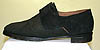 Crooked
Last Shoes - These mens common shoes are black cowhide leather,
rough side out, with leather lining, clumped soles, and thick steel heel
rims. Although they look like they are straight-last shoes these are made
on right and left lasts, ie. crooked shoes. The latchets are 1½"
wide. These shoes were known as 'common' shoes, as opposed to fancier dress shoes. These shoes come in sizes 7 thru 13, in full and half sizes, and in two widths: D (ie medium) and EE (wide). The one exclusion is no size 12½ are available. NO SHOES ARE IN STOCK OR AVAILABLE FOR ORDER. Crooked
Last Shoes - These mens common shoes are black cowhide leather,
rough side out, with leather lining, clumped soles, and thick steel heel
rims. Although they look like they are straight-last shoes these are made
on right and left lasts, ie. crooked shoes. The latchets are 1½"
wide. These shoes were known as 'common' shoes, as opposed to fancier dress shoes. These shoes come in sizes 7 thru 13, in full and half sizes, and in two widths: D (ie medium) and EE (wide). The one exclusion is no size 12½ are available. NO SHOES ARE IN STOCK OR AVAILABLE FOR ORDER.
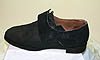
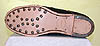 Crooked shoes come with heel rims as pictured.
Hobnails are not available with shoes but you can buy them separately.
Straight Last
Shoes - These mens common shoes are black cowhide leather,
rough side out, with a leather lining. Because they don't have the clumped sole or steel heel rims, these shoes are lighter in weight and more suitable for wearing indoors. The latchets are 1½"
wide. These shoes were known as 'common' shoes, as opposed to fancier dress shoes. These shoes come in sizes 7 thru 13, in full sizes only and only in E width. NO SHOES ARE IN STOCK OR AVAILABLE FOR ORDER. |
 Hi-Lo's
- These mens ankle high shoes are heavy black cowhide leather, rough side
out, clumped soles, and thick steel heel rims. Although they look like
they are straight-last shoes these are made on right and left lasts, ie.
crooked shoes. The photos are of prototype Hi-Lo's made in russet
leather which made it easier to see the seam lines and details. The Hi-Lo's
that I stock are black. The Hi-Lo's are
held closed by a single black leather thong (not pictured, but included)
that is spiral laced. These Hi'Lo's come in sizes 7 thru 13, in full and half sizes, and in two widths: D (ie medium) and EE (wide). The one exclusion is no size 12½ are availabl. NO HI-LO'S ARE IN STOCK OR AVAILABLE FOR ORDER. Hi-Lo's
- These mens ankle high shoes are heavy black cowhide leather, rough side
out, clumped soles, and thick steel heel rims. Although they look like
they are straight-last shoes these are made on right and left lasts, ie.
crooked shoes. The photos are of prototype Hi-Lo's made in russet
leather which made it easier to see the seam lines and details. The Hi-Lo's
that I stock are black. The Hi-Lo's are
held closed by a single black leather thong (not pictured, but included)
that is spiral laced. These Hi'Lo's come in sizes 7 thru 13, in full and half sizes, and in two widths: D (ie medium) and EE (wide). The one exclusion is no size 12½ are availabl. NO HI-LO'S ARE IN STOCK OR AVAILABLE FOR ORDER.
Hi-Lo's were worn by some British officers
as shown in Della Gatta's painting of Germantown and Paoli, by jockeys
as shown in George Stubb's equestrian paintings, and by some Americans
as documented by deserter descriptions in which they are called "half-boots".
For the deserter descriptions see Charles Lefferts Uniforms of the
1775-1783 ... Armies, pages 77, 113, 134, 137.
|
|  Heel
Plates, steel, for affixing
to the heels of your shoes, they help prolong heel life. These heel plates
are 1/16" thick, and much like originals found and on display at
Fort Montgomery, NY - site of a 1777 British attack on this fort on the
Hudson River. $5.00/set with proper nails (ie: 2 plates and 12
nails). Heel
Plates, steel, for affixing
to the heels of your shoes, they help prolong heel life. These heel plates
are 1/16" thick, and much like originals found and on display at
Fort Montgomery, NY - site of a 1777 British attack on this fort on the
Hudson River. $5.00/set with proper nails (ie: 2 plates and 12
nails).
Heel plates are available
in eight sizes, heel rims are no longer available. To determine which
size you need, please download this .pdf file which has tracings of the
plates and rims, and select the size that is the closest match to your
shoe heels. The heel plate sizes do not correspond to shoe sizes and are
not available in any other sizes than listed on the order form. Note that 10/11 is no longer available.
 Heel Plate pdf
Hobnails - Though not commonly used on Rev War period shoes, when hobnails were used it usually was only on the heel. These hobnails have a cone shaped head of approx 1/4" diameter and 5/32" tall. The nail shank is 1/2" long. Available in a bag of 25 nails for $4, or a bag of 75 nails for $10. |
 Shoes Order Form.pdf