



|
|
 Natural
White - Excellent
for smallclothes and coat facings.
The Natural White Kersey matches original War of 1812 period US Army
samples and also closely matched to British clothier patterns. Kersey
was typically used for British other ranks vests and legwear during
the 18th to early 19th century.
Natural
White - Excellent
for smallclothes and coat facings.
The Natural White Kersey matches original War of 1812 period US Army
samples and also closely matched to British clothier patterns. Kersey
was typically used for British other ranks vests and legwear during
the 18th to early 19th century.
Pale Buff - special order broadcloth. A color match to 27th and 40th Regiment of Foot c.1768 facing cloth and a 27th Regiment of Foot c.1812 tailors pattern.
Buff - A color match to an original 1812 US Army Quartermaster samples of captured British buff broadcloth, and an original 1812 coat of the British 104th Regiment of Foot. Among the many uses are British or American facings and smallclothes. 53" wide.
Pale Yellow - From a circa 1811 British pattern for regimental facing cloth. Out of Stock - I don't know when more will be available.
Bright
Yellow
- A color match to the facing
color for the 10th and 29th Foot. Out
of Stock - I don't know when more will be available.
 Deep
Indigo Blue Formerly listed as Dark Blue or Federal Blue. The blue cloth ordered by the various
State and Continental agents from French, Dutch, and Spanish sources
varied in shade. Not all blue cloth used by the Continental Army was
French Royal Blue, though that shade was specified by written contract
for the lottery coats. This shade of blue was used on coats worn by
Gansevoort, Tilghman, civilians, and perhaps by many Continental units
with blue regimental coats that were not part of the French 1778 and
later contracts. This matches cloth samples for the Federal period,
US Army uniform coats and trousers of the period 1806-1840's, and Royal
Artillery cloth samples of the early-mid 19th century. 50" wide
Deep
Indigo Blue Formerly listed as Dark Blue or Federal Blue. The blue cloth ordered by the various
State and Continental agents from French, Dutch, and Spanish sources
varied in shade. Not all blue cloth used by the Continental Army was
French Royal Blue, though that shade was specified by written contract
for the lottery coats. This shade of blue was used on coats worn by
Gansevoort, Tilghman, civilians, and perhaps by many Continental units
with blue regimental coats that were not part of the French 1778 and
later contracts. This matches cloth samples for the Federal period,
US Army uniform coats and trousers of the period 1806-1840's, and Royal
Artillery cloth samples of the early-mid 19th century. 50" wide
 British
Royal Blue
-
This color is for Royal Artillery coats and facings of Royal Regiments
of Foot of the late 18th century. This blue is darker than French Royal
Blue but not as dark as Deep Indigo (Federal) Blue. The kersey is correct
for use in British watch coats. Available in Broadcloth and Kersey.
British
Royal Blue
-
This color is for Royal Artillery coats and facings of Royal Regiments
of Foot of the late 18th century. This blue is darker than French Royal
Blue but not as dark as Deep Indigo (Federal) Blue. The kersey is correct
for use in British watch coats. Available in Broadcloth and Kersey.  French
Royal Blue -
Matched to original c.1778 swatches of cloth for French-made Continental
Army "lottery" coats and a surviving sleeve panel from a Continental
Army uniform coat c.1782. Out
of Stock - I
don't know when more will be available.
French
Royal Blue -
Matched to original c.1778 swatches of cloth for French-made Continental
Army "lottery" coats and a surviving sleeve panel from a Continental
Army uniform coat c.1782. Out
of Stock - I
don't know when more will be available.
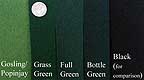
 Grass
Green - This
shade of green is a match to French-made patterns for the Continental
Marines and Continental Light Dragoons, French dragoons and hussars,
and an exact match to an original 18th C. German Jaegers coat, and the
color of the Tarleton jacket. Many Provincial/Loyalist troops could
use grass green, though the darker full green cloth may be preferable
to some units. The grass green color also is a match to an 1812 cloth
pattern for the US Army, a circa 1810 NY militia rifle coatee, and an
1832 US Marine Corps coat.
Grass
Green - This
shade of green is a match to French-made patterns for the Continental
Marines and Continental Light Dragoons, French dragoons and hussars,
and an exact match to an original 18th C. German Jaegers coat, and the
color of the Tarleton jacket. Many Provincial/Loyalist troops could
use grass green, though the darker full green cloth may be preferable
to some units. The grass green color also is a match to an 1812 cloth
pattern for the US Army, a circa 1810 NY militia rifle coatee, and an
1832 US Marine Corps coat.
Gosling/Popinjay
Green - The proper
shade of green for facings of the 5th Foot and 54th Foot. Out
of Stock - I
don't know when more will be available.
Full
Green - A darker
shade of green broadcloth, but not as dark as bottle green. This may
be the proper shade of green for some Provincial/Loyalist infantry coats.
The color was taken from a pattern in a British military tailors notebook
for the11th Regiment of Foot, c.1810.
Bottle Green - Taken from a pattern in a tailors notebook for a British rifle corps c.1800. The British rifle coats were made of broadcloth and their pantaloons and trousers were made of kersey. Available in broadcloth, 53" wide.
 Mixed
Gray - Prior to
the 1740's Mixed Gray kersey was used for Royal Navy sailor jackets
and breeches, and specified in all of the slop contracts that survive
from the 1710-1730s, plus it was probably the most common color, followed
by madder, for the English Civil War armies. Mixed Gray has a long tradition
of usage, especially for the the dress of sailors, tradespeople, farmers,
laborers, etc. This color
was used by British naval and some Continental troops, such as the 3rd
New York Reg't. This broadcloth has a different weave when compared
to the other broadcloths listed here, but is an exact match of the weave
of original mixed gray British Army pantaloons and other 18th C. civilian
and military coatings of mixed gray. Available
in 56" wide broadcloth, or 55" wide kersey.
Mixed
Gray - Prior to
the 1740's Mixed Gray kersey was used for Royal Navy sailor jackets
and breeches, and specified in all of the slop contracts that survive
from the 1710-1730s, plus it was probably the most common color, followed
by madder, for the English Civil War armies. Mixed Gray has a long tradition
of usage, especially for the the dress of sailors, tradespeople, farmers,
laborers, etc. This color
was used by British naval and some Continental troops, such as the 3rd
New York Reg't. This broadcloth has a different weave when compared
to the other broadcloths listed here, but is an exact match of the weave
of original mixed gray British Army pantaloons and other 18th C. civilian
and military coatings of mixed gray. Available
in 56" wide broadcloth, or 55" wide kersey.
Black - For use in regimental facings, spatterdashes/half-gaiters and civilian clothing. Available in broadcloth, 53" wide.
 Madder
Red - Primarily
intended for use on British regimentals. This shade of madder is the
most common found on extant British military coats of the mid to late
18th C. This color is matched to three original British Army other ranks
coats of the late 18th - early 19th C., and an original pattern swatch
for British infantry coats, circa 1820, found in War Office records.
Madder Red kerseys were used for Royal Navy slop jackets. Madder Red
is available in Broadcloth. The kersey is out of stock.
Madder
Red - Primarily
intended for use on British regimentals. This shade of madder is the
most common found on extant British military coats of the mid to late
18th C. This color is matched to three original British Army other ranks
coats of the late 18th - early 19th C., and an original pattern swatch
for British infantry coats, circa 1820, found in War Office records.
Madder Red kerseys were used for Royal Navy slop jackets. Madder Red
is available in Broadcloth. The kersey is out of stock.
Dark
Madder Red -
This shade of madder is also found on extant British military coats
of the 18th and 19th C., but not as common seen as the Madder Red listed
above. This broadcloth is also used by some recreated Rev War and 1812
British units that wish a madder on the dark end of the acceptable madder
color range. The color is obtained from a receipt for madder red published
in 1809. Out
of Stock - I
don't know
when more will be available.
 Mock
Scarlet - This
is slightly brighter than the bright madder red. Superb for 18th C. British
Army serjeants, this is an exact match to a c.1800-1802 serjeant's jacket
of a British volunteer corps, and a pattern dyed for a US Army War of
1812 contract.
Mock
Scarlet - This
is slightly brighter than the bright madder red. Superb for 18th C. British
Army serjeants, this is an exact match to a c.1800-1802 serjeant's jacket
of a British volunteer corps, and a pattern dyed for a US Army War of
1812 contract.
 Brown - Matched
to an original late 18th C. coating swatch in a French military clothier's
book in the A.S.K. Brown Military Collection (Brown University, Providence
R.I.) This is great for for French made Lottery coats or early war American
bounty coats. The kersey is correct for F&I and Rev War slop/sailors
jackets. Out
of Stock - more
should be available in Early Winter 2012.
Brown - Matched
to an original late 18th C. coating swatch in a French military clothier's
book in the A.S.K. Brown Military Collection (Brown University, Providence
R.I.) This is great for for French made Lottery coats or early war American
bounty coats. The kersey is correct for F&I and Rev War slop/sailors
jackets. Out
of Stock - more
should be available in Early Winter 2012.
Pale (Jersey) Drab - This is referred to as "cloth colored" in deserter, runaway, and other period clothing descriptions. Today you would call this color taupe or camel. This drab broadcloth is correct for F&I Provincials, early Rev War (such as the 3rd New Jersey), and working men's dress.
Medium (Avon) Drab - A darker shade of drab, Medium Drab kersey was used for British Marine and Royal Artillery great coats, and US Army watchcoats until 1816. Available in broadcloth and kersey - Only 1 yard available in Broadcloth $60
Red-Brown
Drab -
A
color match of the 1775 Bounty Coat cloth from a swatch attached to the
Massachusetts Provincial Congress Circular
Letter.
NEW
Quaker
Drab -
A
common shade of drab for civilian and militia clothing
NEW Bearskin - used for cloaks, greatcoats, military watch coats. This is a heavy, twilled woolen cloth from hill breeds of sheep. The raised outer surface has a long, shaggy nap laid in the same direction, hence the name Bearskin. Available in Natural White and Quaker Drab. For a mens size 38 about 3 yards needed for watch coat, or 3 1/2 yards with a cape.
 Bay
- 5 oz/sq yd. Commonly used for coat linings
(body and skirt) in the British and German marching regiments until 1802.
Bay is plain weave, with a worsted warp and woolen weft. Warp is the thread
that runs the length of the fabric, weft runs between the selvedge edges.
Bay does not have a nap, unlike Baize which is like a thick flannel. Bay
and Baize are quite different fabrics, and unfortunately the similiar
sounding names were often misspelt and incorrectly used in period texts.
Bay
- 5 oz/sq yd. Commonly used for coat linings
(body and skirt) in the British and German marching regiments until 1802.
Bay is plain weave, with a worsted warp and woolen weft. Warp is the thread
that runs the length of the fabric, weft runs between the selvedge edges.
Bay does not have a nap, unlike Baize which is like a thick flannel. Bay
and Baize are quite different fabrics, and unfortunately the similiar
sounding names were often misspelt and incorrectly used in period texts.
Unlike broadcloth and kersey, where you can lay out your pattern at slight
angles to the warp, with bay you should lay out your pattern along the
straight of goods (ie the warp). This is because the weft is shorter and
coarser fibers, and thus relatively weak as compared to the warp. When
setting in pockets, be sure to line around the pocket opening with Osnaburg
or similiar fabric. This was done on an early 19th C. British army militia/fencibles
jacket we examined. This will help keep the bay from sagging or tearing.
Bay (52" wide) is now available in Natural White (only a few yards available as of July 2012) for $38/yd and colors
for $44/yd: Pale Buff, Buff, Gosling/Popinjay Green, and Mock
Scarlet.
NEW Milled Bay - 8 oz/sq yd, 52" wide. Also known as Double Milled Bay or flannel. Similiar to regular Bay, but one side is milled to raise a nap. Commonly used for waistcoats and French underwear. Natural White. $42/yd
 Serge
- 8 oz/sq yd, 0.03" thick, 60" wide, A lightweight worsted
twill used for coat linings (body and skirt) for British Foot Guards,
horse units, and NCO's. Serge was also used by the French and Continental
Army regiments, and in British standing army regiments of foot after
1802 when it replaced bay. Natural White $48/yd Out
of Stock - I
don't know when more will be available, French Royal Blue and
Mock Scarlet $52/yd.
Serge
- 8 oz/sq yd, 0.03" thick, 60" wide, A lightweight worsted
twill used for coat linings (body and skirt) for British Foot Guards,
horse units, and NCO's. Serge was also used by the French and Continental
Army regiments, and in British standing army regiments of foot after
1802 when it replaced bay. Natural White $48/yd Out
of Stock - I
don't know when more will be available, French Royal Blue and
Mock Scarlet $52/yd.
NEW Milled Serge - 10 oz/sq yd, 53" wide. Also known as Tricot, Double Milled Serge, or Heavy Serge. Similar to regular Serge, but one side is milled to raise a nap. This cloth was used by the French army for smallclothes, the smallcloths that accompanied Continental Army French-made Lottery coats, watch coat linings, sleeved waistcoats in 1812, etc. Available in Natural White $52/yd.
|
A Guide to Regimental Coat Cloth 1775-1783 |
|||
|
Coat |
Facing |
Lining |
|
|
British Reg't of Foot - Private or Corporal |
Madder Red Broadcloth |
Broadcloth - color per Royal Warrant (color varies by regiment) |
White Bay, unless a Buff faced regiment |
|
British Reg't of Foot - Serjeant |
Mock Scarlet Broadcloth |
Broadcloth - color per Royal Warrant (color varies by regiment) |
White Serge, unless a Buff faced regiment |
|
British Reg't of Foot - Officer |
Scarlet Superfine Broadcloth |
Superfine Broadcloth - color per Royal Warrant (color varies by regiment) |
White Shalloon, unless a Buff faced regiment |
| British Reg't of Foot - Drums |
Broadcloth
of regimental facing color |
Madder
Red or Mock Scarlet Broadcloth for facings and smallclothes for red,
buff, and white faced regiments. |
Madder
Red or Mock Scarlet Serge for those with red smallclothes, otherwise
white serge except for Buff faced regiments. |
|
British Light
Dragoons |
Mock Scarlet Broadcloth |
16th
- Royal Blue Broadcloth |
16th
- Royal Blue Serge |
| Royal Artillery |
Royal Blue Broadcloth |
Mock Scarlet Broadcloth |
Mock Scarlet Serge |
|
Guard Reg'ts |
Madder
Red Broadcloth |
Royal Blue Broadcloth |
White Serge |
| British Marines |
Madder
Red Broadcloth |
White Broadcloth |
White Bay |
|
|
|||
|
Continental Army |
|||
| Contract and French made coats for Soldiers |
Broadcloth
- color varies by regiment |
Broadcloth
- color varies by regiment |
Serge
- color varies by regiment |
|
Prior to Seven Years War and
up to 1768 Warrant |
|||
| British Reg't of Foot - Private or Corporal | Madder Red Broadcloth
coats and waistcoats. Madder Red Kersey breeches. Bay lining that matched the facing color. Undress jackets and frocks (new issued, not altered old clothing) of Madder Red Kersey. |
||